
Guhlen II
Towards local helium production in Germany!
Bibliographic research and field measurements have shown a gas mix rich in nitrogen and helium in the Guhlen II area.
In June 2023, 45-8 ENERGY submitted an exploration license application to the regional mining authority, the LBGR. The license was granted in April 2025 for a period of five years. Located in the state of Brandenburg, southeast of Berlin, the exploration license covers an area of 641 km² and concerns helium resources.
The granting of this exploration license and the subsequent validation of the assumptions would enable the exploitation of helium and any associated gases.
Guhlen II project
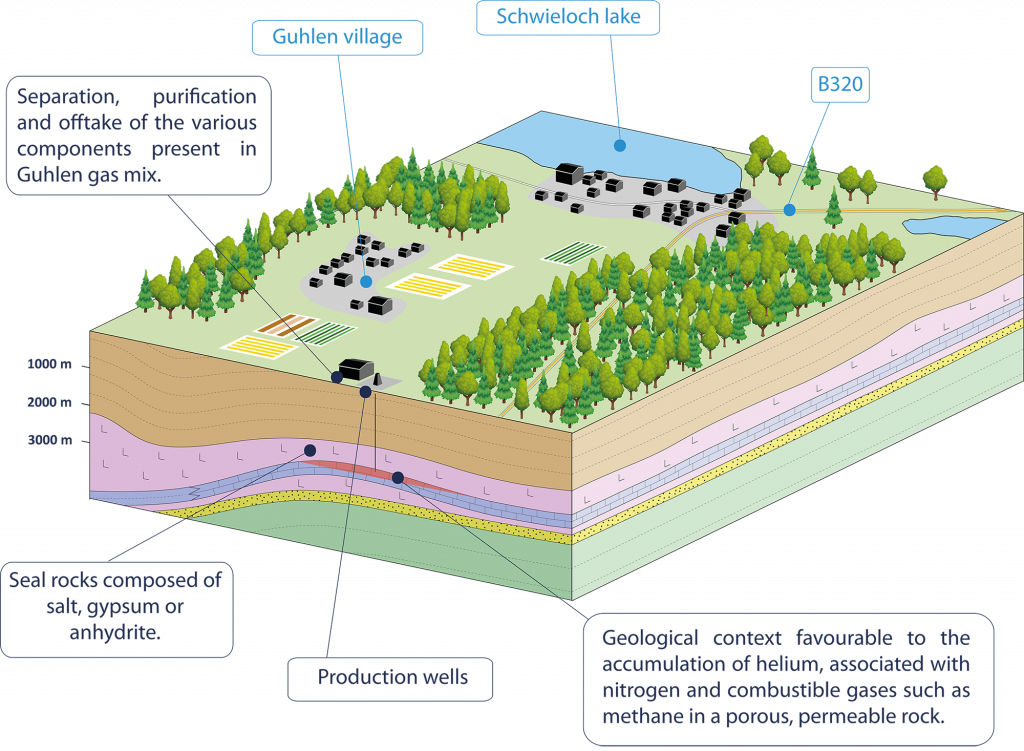
Bibliographic research and field measurements have been carried out in the past, demonstrating significant helium potential in the area known as “Guhlen II.” The license was granted to 45-8 ENERGY in April 2025 and covers an area of 641 km² in the state of Brandenburg, southeast of Berlin, Germany. The purpose of this exploration license is to further develop geological knowledge of the area and confirm its helium potential.
The exploration license has been accepted for a period of five years in order to acquire the data necessary to confirm the accumulation of a gas mix rich in helium.
Beyond the Guhlen II area, 45-8 ENERGY is convinced of the potential of this particular geological region, where high helium content has been widely reported in the past but has never led to significant production due to a lack of use at the time.
Size of the exploration area
641 km²
Size of the exploration area
Granted period
5 years
Granted period
Depth at which the discovery is located
2500 m
Depth at which the discovery is located
Exploration area
The Guhlen II exploration license covers an area of 641 km² in Brandenburg, south-east of Berlin.
The perimeter is intentionally vaste, in order to gain a comprehensive understanding of geology of the area, and then to target high-potential zones more precisely as acquisitions are made.
Gases of the area
Helium
The gas mix in the Guhlen II area consists of a helium fraction combined with nitrogen and methane, important to co-value in an smart and innovative way.
Helium is at the heart of our business, and its potential is important for Germany’s national sovereignty and the supply of helium in Western Europe.
Nitrogen
Guhlen II gas is composed mainly of nitrogen.
Nitrogen is the most abundant element in the Earth’s atmosphere (it accounts for approximately 78% of its composition). Due to the abundance of nitrogen in the air, its appeal is limited and its economic use unlikely.
Its release to the atmosphere has no risks for the population and the environment (does not contribute to the greenhouse effect).
Methane
The proportion of natural gas present in the gas mix discovered in the Guhlen II area is considered an opportunity for innovation.
In order to recover this fraction of gas, 45-8 ENERGY plans to produce low-carbon, locally sourced hydrogen using several technological approaches:
- through steam reforming with recovery and/or sequestration of the carbon dioxide emitted in the process (mineralization or reinjection into its original reservoir underground)
- through pyrolysis/plasmolysis, enabling the production of hydrogen and black carbon.
Key steps
* Projected calendar
Work program
The work program will be carried out to reconcile industrial activity with respect for the environment and local residents, developing innovative technologies and methodologies, already tested on our French projects.
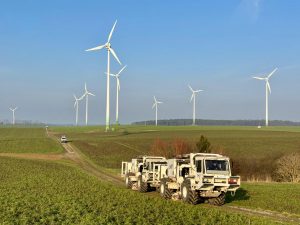
Geological and geophysical acquisitions
Confirm the helium production potential at the existing Guhlen II discovery.
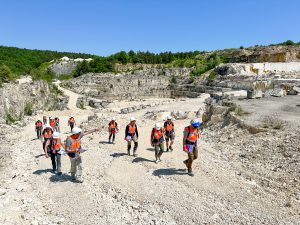
Additional work
Identify all exploration potential within the license area in order to consider carrying out additional exploration drilling.
A local and strategic project
Guhlen II provides means of securing a local supply of helium for an entire region of Germany, which is currently in high demand and subject to recurrent risks of shortages.
Germany uses 9.5 millions m³ of helium each year, making it the world's 5th largest consumer, and is also largely dependent on imports. Silicon Saxony, which covers Dresden and the surrounding area, is the largest microelectronics site in Europe and the 5th largest in the world.
This type of industry requires large volumes of helium to operate. The electronics industry accounts for 25% of global helium consumption. Since the Guhlen project is located 100 km away from Dresden and, more specifically from the Silicon Saxony. The helium produced will be distributed directly to microelectronics companies in this major competitive cluster. In addition, INTEL™ is planning to build two semiconductor production facilities in Magdeburg, located 230 km away from the project, by the end of the decade.
Part of our helium production could thus be dedicated to supplying these units, which consume large amount of helium and are essential to meet the needs of the New Tech.
The eastern part of Germany is an important industrial region with many major consumers of hydrogen (green mobility, steel industry, chemical industry).
As part of the energy and ecological transition, projects using hydrogen are multiplying and the consumption of this resource should double by 2030, from 55 TWh (in 2020) to 110 TWh (in 2020). The hydrogen produced from the methane fraction of the Guhlen project will therefore contribute to the decarbonation of local industries, in search of a secure and more eco-responsible supply.
For example, part of the hydrogen from the Guhlen II project could be sent to the ArcelorMittal steel plant, located 50 km away, which is planning to produce eco-responsible steel, powered by hydrogen.
Germany is both the largest producer and the largest consumer of industrial carbon dioxide in Western Europe.
However, the production of the resource is mostly concentrated in the West of Germany. And carbon dioxide from the eastern part of Germany is mainly generated by the seasonal production of ammonia.
Carbon dioxide produced on the Guhlen II project will thus ensure a local, reliable and secure supply to numerous consumer companies in the region. These companies are very diversified and involve the carbonated beverage (beer, soft drinks, water...), the chemical and the cryogenic industries.

