
Banjë e Vuçës
Natural hydrogen at the heart of Europe
Following bibliographic research and initial field measurements, 45-8 ENERGY realized that northern Kosovo is conducive to a unique geological process called “serpentinization,” which causes the concentration of nickel and iron alloys and also allows hydrogen to be generated underground.
In order to further its overall geological knowledge of the area and confirm the technical and economic viability of a project to develop these resources, in January 2023, 45-8 ENERGY applied for an exploration license covering an area of 57.5 km² in the municipality of Leposavić.
The exploration license is expected to be granted by the competent authorities in the coming months. Several acquisition campaigns to improve imaging of the subsoil using indirect, non-invasive techniques that respect the environment and local residents will then be carried out over the three-year license period. If the results are positive, one or more boreholes followed by production tests will be considered.
Banjë e Vuçës exploration license
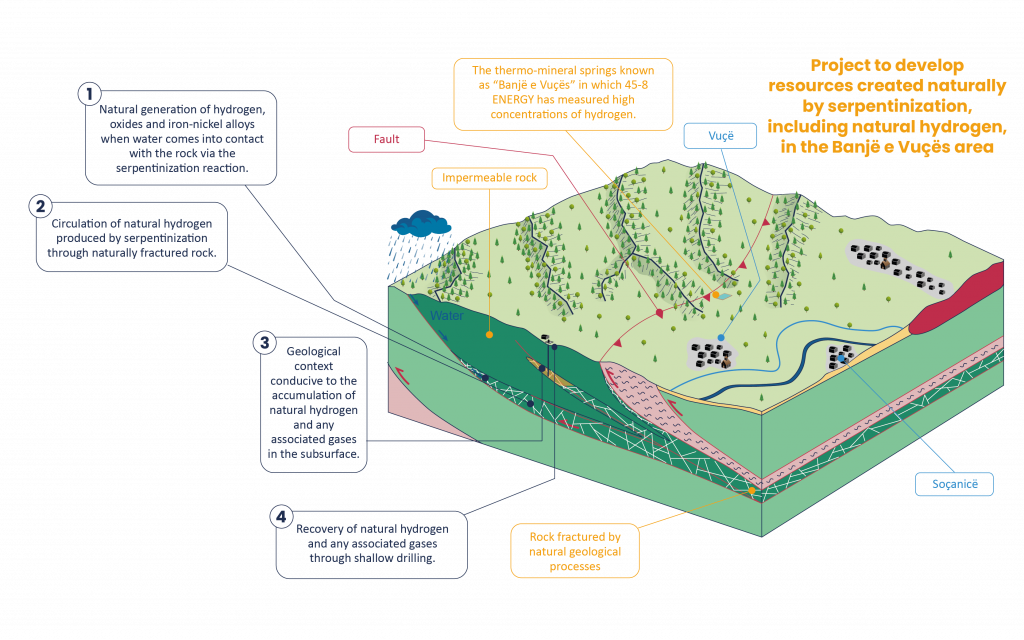
Based on bibliographical research and initial field measurements, the Dinarides region, including Kosovo, appears favorable for hydrogen occurrence in several of its thermo-mineral springs.
In January 2023, 45-8 ENERGY submitted an application for an exploration licence named ‘Banjë e Vuçës’, which is currently being examined by the local authorities. This exploration licence will make it possible to fully assess the hydrogen potential of the area and confirm the technical and economic viability of a project to produce the resource.
The exploration work to be carried out under the ‘Banjë e Vuçës’ license will also provide a better understanding of the concept of ‘serpentinisation’ and will make it possible to assess and clarify certain aspects related to the operation and potential of the mechanism.
This license therefore represents a promise both for the launch of the hydrogen industry in Kosovo and the Dinarides region and for the understanding of the global geological system of natural hydrogen.
What if the exploration phase proves successful?
If the exploration phase is positive and the hydrogen potential is confirmed, local production of the resource will be considered.
The infrastructure will be compact with a small footprint, equivalent to an agricultural warehouse, enabling the project’s impact on the ground and its ecological footprint to be limited. In addition, 45-8 ENERGY is working to ensure that its projects are fully integrated into the local area and landscape (buildings that respect local architecture, wood cladding, use of solar panels, etc.).
Location of the Banjë e Vuçës license

The “Banjë e Vuçës” exploration license covers an area of 57.5 km2 over the municipality of Leposavić, in northern Kosovo.
Key steps
Theoretical dates. The steps to be taken will depend on the time required to process the exploration license application with the competent authorities.
Work program
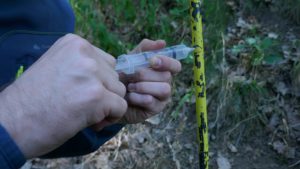
Soil gas sampling
It consists of analysing in the laboratory the composition of small gas volumes sampled from the soil using a syringe and a cannula buried one meter into the ground.

Gravimetry
Its enables using a gravimeter (small portable device) to measure minor variation of the Earth’s gravitational field and to deduce the rock nature in the subsurface.
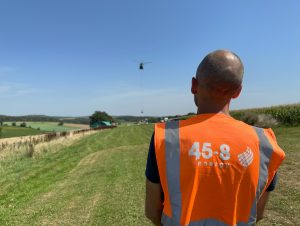
Airborne electromagnetism
Airborne electromagnetism is used to assess the electrical resistivity properties of geological formations underground. For this acquisition, a helicopter emits an electromagnetic wave via a coil towed underneath the device, following a predetermined regular path. The acquisition device then receives a 3D response of the subsurface.
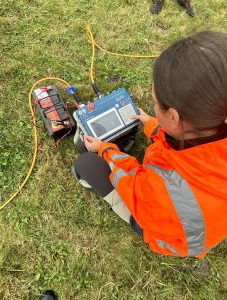
Electrical resistivity tomography
This technique enables to deduce the subsurface geology by assessing electrical conductivity variations in the soil. Small electrodes are planted in the ground at a depth of 10 cm and are connected to a measuring device to obtain a 2D image of the prospected area.
Soil gas sampling
It consists of analysing in the laboratory the composition of small gas volumes sampled from the soil using a syringe and a cannula buried one meter into the ground.
Natural hydrogen FAQ
Is native hydrogen natural?
Native hydrogen is produced naturally by the Earth in the subsurface. Its formation requires no critical materials or anthropogenic energy and has no impact on available drinking water resources. “Native hydrogen,” “natural hydrogen,” and “white hydrogen” are all terms used to describe this hydrogen produced naturally by our planet.
How is hydrogen generated?
The natural formation of hydrogen in the subsurface can have several origins. In the context of the Grand Rieu exploration license, hydrogen is formed through the transformation of rocks from the Earth’s mantle reacting with water that seeps through existing faults. This process, called serpentinization, generates a rock called serpentine, as well as natural hydrogen.
Is natural hydrogen a decarbonized resource?
Yes! Natural hydrogen, produced naturally underground, is a totally carbon-free resource. Its production requires no critical materials, anthropogenic energy or water, and enables the resource to be valorized at extremely competitive costs, making it a direct contribution to the energy and ecological transition.
Why produce natural hydrogen?
Native hydrogen has a role to play in the decarbonization of industry and mobility. This type of hydrogen could easily be integrated into the existing low-carbon hydrogen mix as a natural, decarbonized and competitive resource.

